"Sword" • Chinese-English Dictionary

DICTIONARY OPTIONS
CHARACTERS : Simplified Traditional
PHONETIC : Pinyin Bopomofo EFEO Wade-Giles Yale
» Search by Radical
 bǎo jiàn (double-edged) sword (esp. a valuable or famous one) / CL:把[ba3]
 dāo jiàn sword
 xuān yuán jiàn sword
 pèi jiàn sword / (fencing) saber
 gāng dāo steel knife / sword
 Gōu rope attached to a sword hilt / (archaic) hilt / sword
 jiá pincers for use at a fire / sword
 dāo fēng cutting edge or point of a knife, sword or tool
 lì jiàn sharp sword
 jiàn shēn sword blade
 chū qiào (of a sword etc) to unsheath
 dāo qiāng sword and spear / weapons
 jiàn bǐng sword hilt
 shuāng rèn jiàn double-edged sword (lit. and fig.)
 mù jiàn wooden sword
 mǎ dāo saber / cavalry sword
 kuài dāo zhǎn luàn má lit. quick sword cuts through tangled hemp (idiom) / decisive action in a complex situation / cutting the Gordian knot
 bái rèn naked sword
 shàng fāng bǎo jiàn variant of 尚方劍|尚方剑[shang4 fang1 jian4] / imperial sword (giving bearer arbitrary powers) / in fiction, Chinese version of 007's license to kill
 Rì běn dāo Japanese sword / katana
 bǎo dāo bù lǎo lit. a good sword always remains sharp (idiom) / fig. (of one's skills etc) to be as good as ever / the old man still has it
 kǒu mì fù jiàn lit. honeyed words, a sword in the belly (idiom) / fig. hypocritical and murderous
 tóu bǐ cóng róng to lay down the pen and take up the sword (idiom) / to join the military (esp. of educated person)
 kè zhōu qiú jiàn lit. a notch on the side of a boat to locate a sword dropped overboard (idiom) / fig. an action made pointless by changed circumstances
 dān dāo fù huì lit. to go among enemies with only one's sword (idiom) / fig. to go alone into enemy lines
 dāo knife / blade / single-edged sword / cutlass / CL:把[ba3] / (slang) dollar (loanword) / classifier for sets of one hundred sheets (of paper) / classifier for knife cuts or stabs
 lūn to swing (one's arms, a heavy object) / to wave (a sword, one's fists) / to fling (money)
 kūn steel sword
 xín guard (on a sword handle) / pommel (on a sword handle) / dagger / Taiwan pr. [tan2]
 guāng point of a sword
 máng sharp point / point of sword
 wén wǔ shuāng quán well versed in letters and military technology (idiom) / fine scholar and soldier / master of pen and sword
 qín jiàn piāo líng floating between zither and sword (idiom) / fig. wandering aimlessly with no tenured position
 kuà xià zhī rǔ lit. the humiliation of having to crawl between the legs of one's adversary (as Han Xin 韓信|韩信[Han2 Xin4] supposedly did rather than engage in a sword fight) (idiom) / fig. (endure) utter humiliation
 Xiàng Zhuāng wǔ jiàn lit. Xiang Zhuang performs the sword dance, but his mind is set on Liu Bang 劉邦|刘邦[Liu2 Bang1] (idiom, refers to plot to kill Liu Bang during the Hongmen feast 鴻門宴|鸿门宴[Hong2 men2 yan4] in 206 BC) / fig. an elaborate deception hiding malicious intent
 mó dāo huò huò lit. to sharpen one's sword (idiom) / fig. to prepare to attack / to be getting ready for battle
 dāo qiāng bù rù lit. impervious to sword or spear (idiom) / fig. invulnerable / untouchable / thick-skinned / impervious to criticism
 shì a sword. potter's clay. to gather
 shàng fāng bǎo jiàn imperial sword (giving bearer plenipotentiary powers) / imperial Chinese version of 007 licensed to kill
 Yǐ tiān Tú lóng Jì Heaven Sword and Dragon Saber, wuxia (武俠|武侠[wu3 xia2], martial arts chivalry) novel by Jin Yong 金庸[Jin1 Yong1] and its screen adaptations
 jiàn zǒu piān fēng the sword moves with side stroke (modern idiom) / fig. unexpected winning move / unconventional gambit
 jiàn zǒu qīng líng the sword moves like a dragon-fly (modern idiom) / fig. unexpected winning move / unconventional gambit
 dà dāo huì Great Sword Society, an offshoot of the White Lotus in the late Qing dynasty, involved in anti-Western activity at the time of the Boxer rebellion
 shàng fāng jiàn imperial sword (giving bearer arbitrary powers) / in fiction, Chinese version of 007's license to kill
 kuài dāo duàn luàn má lit. quick sword cuts through tangled hemp (idiom) / decisive action in a complex situation / cutting the Gordian knot
 dǎ bǎ shi drill (in sword play) / to thrash around / to demonstrate gymnastic skills / to solicit financial help (in an indirect way) / to show off
 Tài ē name of a famous sword mentioned in ancient texts
 bǐ shèng yú dāo wén bǐ wǔ qiáng the pen is mightier than the sword (idiom)
 zhòng wén qīng wǔ to value letters and belittle arms (idiom) / to stress civil matters and neglect the military / to prefer the pen to the sword
 Xiàng Zhuāng wǔ jiàn , yì zài Pèi Gōng lit. Xiang Zhuang performs the sword dance, but his mind is set on Liu Bang 劉邦|刘邦[Liu2 Bang1] (idiom) / refers to 206 BC plot to murder Liu Bang, aka Duke of Pei 沛公[Pei4 gong1] and the future Han emperor, during a sword dance at the Hongmen feast 鴻門宴|鸿门宴[Hong2 men2 yan4] / an elaborate deception to hide malicious intent

 zhú dāo shinai (bamboo sword for kendō)
 fēng dāo to hang up the sword
 kāi rèn to edge a knife, scissor, sword etc
 liǎng miàn rèn double-edged sword
 dào chí - Tài ē lit. to present the handle of a sword to another (idiom) / fig. to relinquish power to another / to place oneself at another's mercy
 pō dāo sword with a curved blade and a long hilt, wielded with both hands
 Mò yé Moye, the name of a legendary double-edged sword
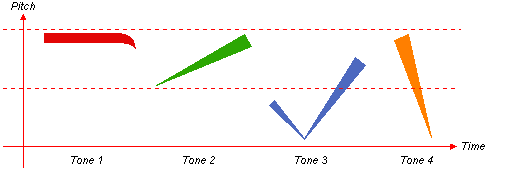
Chinese Tones