"Parts" • Chinese-English Dictionary

DICTIONARY OPTIONS
CHARACTERS : Simplified Traditional
PHONETIC : Pinyin Bopomofo EFEO Wade-Giles Yale
» Search by Radical
 shí fēn very / completely / utterly / extremely / absolutely / hundred percent / to divide into ten equal parts
 gè dì in all parts of (a country) / various regions
 pèi hé matching / fitting in with / compatible with / to correspond / to fit / to conform to / rapport / to coordinate with / to act in concert with / to cooperate / to become man and wife / to combine parts of machine
 wài dì parts of the country other than where one is
 lián xù jù serialized drama / dramatic series / show in parts
 shì jiè gè dì all over the world / everywhere / in all parts of the world
 lián dòng (of the parts of a machine) to move together / to act in coordination / to be coupled / linkage
 hú lu calabash or bottle gourd (Lagenaria siceraria) / hoist / generic term for block and tackle (or parts thereof) / muddled / (poker) full house
 qì pèi auto parts
 Dà Zhōng huá Greater China / refers to China, Taiwan, Hong Kong and Macau (esp. in finance and economics) / refers to all areas of Chinese presence (esp. in the cultural field), including parts of Southeast Asia, Europe and the Americas
 sī chù private parts / genitalia
西 Xī Xià Western Xia dynasty 1038-1227 of Tangut people 黨項|党项 / occupying modern Ningxia and parts of Gansu and Shaanxi, overthrown by Mongols
 chāi fēn to break up into parts
 Huái hǎi Huaihai, economic hub around Xuzhou 徐州[Xu2 zhou1], including parts of Jiangsu, Shandong, Henan and Anhui provinces
 bèi jiàn spare parts
 qiān lǐ tiáo tiáo from distant parts
 fēn liè to divide into rows / to identify subcategories / to break down into constituent parts / breakdown / disaggregation
 zhī jiě to dismember / (fig.) to break into parts
 wǔ hú sì hǎi all parts of the country
 Huā guǒ Shān Mount Huaguo in Jiangsu, featured in 西遊記|西游记[Xi1 you2 Ji4], tourist destination / (also the name of mountains in other parts of China)
 zǔ fèn components / individual parts making up a compound
 sǎn jiàn spare parts / odds and ends
 pīn chéng to put sth together from component parts
 děng fēn to divide into equal parts
 wǔ fāng the five regions: the east, south, west, north and center / all parts / China and the lands beyond its frontiers
 lǐ lòng lanes and alleys / neighborhood / lane neighborhoods in parts of Shanghai, with modified Chinese courtyard houses, occupied by single families in the 1930s, now crowded with multiple families
 bā gǔ an essay in eight parts / stereotyped writing
 bèi pǐn machine parts or tools kept in reserve / spare parts
 fēn zū (of a landlord) to rent out one or more parts of a property / (of a tenant) to sublet one or more parts of a property / (agriculture) sharecropping
 yuǎn mén (to go to) distant parts / faraway / a distant relative
 wǔ hóu cí temple dedicated to the memory of Zhuge Liang 諸葛亮|诸葛亮[Zhu1 ge3 Liang4] (There is one in Chengdu, and many others in various parts of China.)
 tuō jiāo (of parts glued together) to come apart
 Dà shā Hé Dasha River (the name of rivers in various parts of China)
 shǎng unit of land area (equivalent to 10 or 15 mǔ / 畝|亩[mu3] in parts of northeast China, but only 3 or 5 mǔ / in northwest China)
 fú gǔ xiāng yìng lit. the hammer fits the drum (idiom) / appropriate relation between the different parts / closely interrelated
亿  parts per billion
 Gé sī tǎ Gestalt (loanword) / coherent whole / technical word used in psychology meaning the whole is more than the sum of its parts / holistic / integrated / total / also written 格式塔
 biàn wén a popular form of narrative literature flourishing in the Tang Dynasty (618-907) with alternate prose and rhymed parts for recitation and singing (often on Buddhist themes)
 fù parts of cart holding the axle
 zhuā fàn pilaf (rice dish popular in many parts of the world, including Xinjiang)
 chuán tǒng cí lèi traditional parts of speech (grammar)
 kǒu bái narrator / spoken parts in an opera
 dà Zhōng huá qū greater China / refers to China, Taiwan, Hong Kong and Macau (esp. in finance and economics) / refers to all areas of Chinese presence (esp. in the cultural field), including parts of Southeast Asia, Europe and the Americas
 Huī yǔ Huizhou dialect of Gan, spoken in southern parts of Anhui Province
 jīn jié lit. muscles and joints / by ext. the relations between parts in a speech, composition etc
 Lóng gé ěr former Lunggar county 1983-1999 occupying parts of Zhongba county 仲巴縣|仲巴县[Zhong4 ba1 xian4], Ngari prefecture, Tibet
 Lóng gé ěr xiàn former Lunggar county 1983-1999 occupying parts of Zhongba county 仲巴縣|仲巴县[Zhong4 ba1 xian4], Ngari prefecture, Tibet
 líng jiàn gōng huò shāng supply of spare parts
 huáng tǔ bù lù tiān a slogan used in reference to a project to improve greenery in some parts of Northern China
EUROP货  Customs Convention concerning Spare Parts used for repairing EUROP Wagons
  working parts
  Central African Convention for the Control of Small Arms and Light Weapons, Their Ammunition and All Parts and Components That Can Be Used for Their Manufacture, Repair and Assembly / Kinshasa Convention

亿  parts per trillion
  Parts Clerk
 quán shī intact corpse / dead body with no parts missing
 shī kuài body parts (of a mutilated corpse)
 Huái hǎi dì qū Huaihai, economic hub around Xuzhou 徐州[Xu2 zhou1], including parts of Jiangsu, Shandong, Henan and Anhui provinces
 jī tū protruding nipples or bulging penis (contours of intimate body parts visible through clothing)
 liào jiàn materials and parts / components
 xiào diǎn funny bits / humorous parts / jokes / punchline
宿 Sù wù yǔ Cebuano (aka Bisaya), language spoken in parts of the Philippines
宿 Sù wù yǔ Cebuano (aka Bisaya), language spoken in parts of the Philippines (Tw)
 gē tái boisterous live show held during the Ghost Festival 中元節|中元节[Zhong1 yuan2 jie2] in Singapore and other parts of Southeast Asia
 shǒu zhuā fàn pilaf (rice dish popular in many parts of the world, including Xinjiang) / pilau
 céng cì fēn míng layered / structured / made up of distinct parts
4S店 4S - diàn authorized full-service car dealership (offering sales, spare parts, after-sales service and customer support)
 tiāo féi - jiǎn shòu (idiom) to cherry-pick / to pick the best parts for oneself / to be choosy
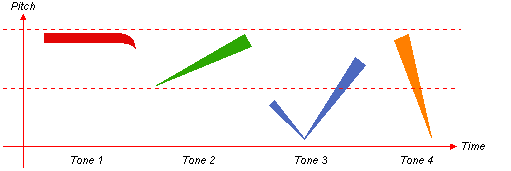
Chinese Tones