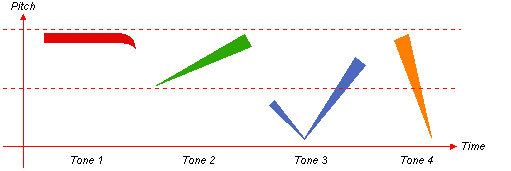
to leave (the stage, an exam room, the playing field etc) / to take part in some activity / to take an examination (in the imperial examination system)
唐山
Táng shān
see 唐山市[Tang2shan1 Shi4] / China (a name for China used by some overseas Chinese)
morning and evening / (in reference to sth that is bound to happen) sooner or later / one of these days / (coll.) (this, or that) point of time / (dialect) at some time in the future
留空
liú kòng
to leave blank space in a document / to leave some time free
业者
yè zhě
dealer / trader / person or company engaged in some industry or trade
老兵
lǎo bīng
old soldier / veteran / veteran (sb who has a lot of experience in some domain)
定居
dìng jū
to settle (in some city, country etc) / to take up residence
分身
fēn shēn
(of one who has supernatural powers) to replicate oneself so as to appear in two or more places at the same time / a derivative version of sb (or sth) (e.g. avatar, proxy, clone, sockpuppet) / to spare some time for a separate task / to cut a corpse into pieces / to pull a body apart by the four limbs / parturition
(third-person singular) (since the early 20th century, usu. male) he / him / his / (bound form) other / another / some other (as in 他日[ta1ri4] and 他人[ta1ren2])
苏丹
Sū dān
Sudan / sultan (ruler of some Muslim states, esp. Ottoman Emperor)
lit. to hang upside down / fig. topsy-turvy and inequitable, e.g. manufacturing and trading costs exceed the sale price (of some goods) / to borrow more than one can ever repay
楔子
xiē zi
wedge / peg / stopper / prologue (in some modern novels) / prologue or interlude in Yuan dynasty drama
问路
wèn lù
to ask for directions / to ask the way (to some place)
真人版
zhēn rén bǎn
real-life version (of some imaginary character)
次之
cì zhī
to rank second (in terms of some attribute: size, frequency, quality etc)
吃住
chī zhù
food and lodging / to stay (at some place) and eat meals (there)
退场
tuì chǎng
to leave a place where some event is taking place / (of an actor) to exit / (sports) to leave the field / (of an audience) to leave
分神
fēn shén
to give some attention to / to divert one's attention / to be distracted
home / family / (polite) my (sister, uncle etc) / classifier for families or businesses / refers to the philosophical schools of pre-Han China / noun suffix for a specialist in some activity, such as a musician or revolutionary, corresponding to English -ist, -er, -ary or -ian / CL:個|个[ge4]
割肉
gē ròu
to cut some meat / to cut off a piece of flesh / (fig.) (coll.) to sell at a loss
进逼
jìn bī
to advance on sth / to press closely (on some goal)
classifier for birds and certain animals, one of a pair, some utensils, vessels etc
帮腔
bāng qiāng
vocal accompaniment in some traditional Chinese operas / to speak in support of / to chime in
国子监
Guó zǐ jiàn
Guozijian, the highest educational administrative body in imperial China, in some dynasties also functioning as the highest institution of academic research and learning (Imperial College, aka Imperial Academy)
to compare / (followed by a noun and adjective) more {adj.} than {noun} / ratio / to gesture / (Taiwan pr. [bi4] in some compounds derived from Classical Chinese)
lit. first execute the criminal, then report it to the emperor (idiom) / fig. to take some drastic action without the prior approval of higher authorities
to bow to / to pay one's respects / (bound form) to extend greetings (on a specific occasion) / to make a courtesy call / (bound form) (of a monarch) to appoint sb to (a position) by performing a ceremony / to acknowledge sb as one's (master, godfather etc) / (used before some verbs to indicate politeness)





 liǎng
liǎng