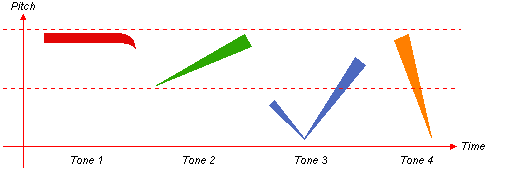
to receive a radio signal / to make an audio recording / (of an auditorium etc) to have good acoustics / (vocal training, linguistics) ending (of a word or syllable)
to apply (knowledge etc) creatively and flexibly / to use a word flexibly (e.g. a noun as an adjective)
感化
gǎn huà
corrective influence / to reform (a criminal) / redemption (of a sinner) / to influence (a malefactor to a better life) / to guide sb back to the right path by repeated word and example
一窍不通
yī qiào bù tōng
lit. doesn't (even) enter a single aperture (of one's head) / I don't understand a word (idiom) / it's all Greek to me
single-character headword (in a dictionary) / first character of a Chinese word / the top part (esp. a radical) of a Chinese character / the initial of a Chinese syllable
音译
yīn yì
transliteration (rendering phonetic value, e.g. of English words in Chinese characters) / characters giving phonetic value of Chinese word or name (when the correct characters may be unknown) / transcription (linguistics) / to transcribe phonetic symbols
吱声
zhī shēng
to utter a word / to make a sound / to cheep / to squeak / also pr. [zi1 sheng1]
lit. to guard one's mouth like a closed bottle (idiom) / tight-lipped / reticent / not breathing a word
出尔反尔
chū ěr fǎn ěr
old: to reap the consequences of one's words (idiom, from Mencius) / modern: to go back on one's word / to blow hot and cold / to contradict oneself / inconsistent
一语道破
yī yǔ dào pò
one word says it all (idiom) / to hit the nail on the head / to be pithy and correct
quilt / to cover (with) / (literary) to suffer (a misfortune) / used to indicate passive voice (placed before the doer of the action like "by" in English passive-voice sentences, or, if the doer is not mentioned, before the verb) / (since c. 2009) (sarcastic or jocular) used to indicate that the following word should be regarded as being in air quotes (as in 被旅遊|被旅游[bei4 lu:3you2] to "go on a trip")
成语接龙
chéng yǔ jiē lóng
game where the last word of one idiom 成語|成语[cheng2 yu3] is the first of the next
particle indicating that a previously asked question is to be applied to the preceding word ("What about ...?", "And ...?") / particle for inquiring about location ("Where is ...?") / particle signaling a pause, to emphasize the preceding words and allow the listener time to take them on board ("ok?", "are you with me?") / (at the end of a declarative sentence) particle indicating continuation of a state or action / particle indicating strong affirmation
to write without lifting one's pen from the paper / (in the Romanization of Chinese) to write two or more syllables together as a single word (not separated by spaces)





 zì
zì