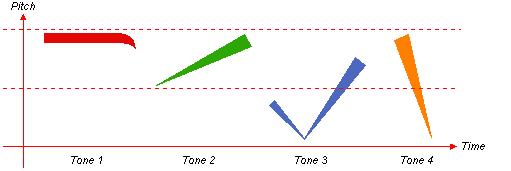
that one / that thing / that (as opposed to this) / (used before a verb or adjective for emphasis) / (used to humorously or indirectly refer to sth embarrassing, funny etc, or when one can't think of the right word) / (used in speech as a filler, similar to "umm", "you know" etc) / (euph.) menstruation / sex / also pr. [nei4 ge5]
一点
yī diǎn
a bit / a little bit / (used in negative expressions) (not) the least bit / (after an adjective, used to form the comparative) a bit more, -er / a point (in a discussion etc) / (calligraphy) dot stroke (、) / one o'clock (abbr. for 一點鍾|一点钟[yi1 dian3zhong1])
of / ~'s (possessive particle) / (used after an attribute when it modifies a noun) / (used at the end of a declarative sentence for emphasis) / (used after a noun, verb or adjective to form a nominal expression, as in 皮革的[pi2ge2 de5] "one made of leather" or 跑堂兒的|跑堂儿的[pao3tang2r5de5] "a waiter (literally, one who runs back and forth in a restaurant)" or 新的[xin1 de5] "new one") / also pr. [di4] or [di5] in poetry and songs
何其
hé qí
(literary) (similar to 多麼|多么[duo1 me5], used before an adjective in exclamations) how (fortunate etc) / so (many etc)
good / appropriate / proper / all right! / (before a verb) easy to / (before a verb) good to / (before an adjective for exclamatory effect) so / (verb complement indicating completion) / (of two people) close / on intimate terms / (after a personal pronoun) hello
again / once more / re- / further / beyond this point of time / (before an adjective) more / then (after sth, and not until then) / no matter how ... (followed by an adjective or verb, and then (usually) 也[ye3] or 都[dou1] for emphasis) / (used to introduce additional information, as in 再則|再则[zai4ze2], 再就是[zai4jiu4shi4] etc) / (literary) to reappear / to reoccur
particle used between an adverb and a verb or adjective / (dialect) particle used after a negative adverb such as 不[bu4] or 別|别[bie2] without any other following element





 de
de