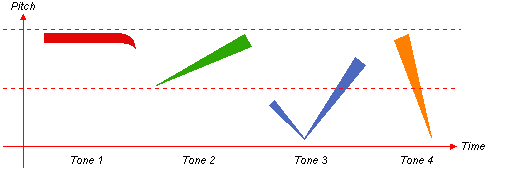
the four social bonds: propriety, justice, integrity and honor / see 禮義廉恥|礼义廉耻[li3 yi4 lian2 chi3] / the four directions / the four limbs (Chinese medicine) / four-dimensional
久仰
jiǔ yǎng
honorific: I've long looked forward to meeting you. / It's an honor to meet you at last.
to lift sth up / to elevate sb / to honor sb (with compliments, gifts, promotions etc) / to show great regard / to speak highly / Taiwan pr. [tai2 ju3]
抬举
tái jǔ
to lift sth up / to elevate sb / to honor sb (with compliments, gifts, promotions etc) / to show great regard / to speak highly
(of a distinguished guest) honor my house (firm etc) with your presence
大紫荆勋章
dà zǐ jīng xūn zhāng
Great Bauhinia Medal (GBM), Hong Kong's highest honor
久慕
jiǔ mù
lit. I've admired you for a long time (honorific). / I've been looking forward to meeting you. / It's an honor to meet you at last.
久慕盛名
jiǔ mù shèng míng
(idiom) I've admired your reputation for a long time / it's an honor to meet you at last
五常
wǔ cháng
the five cardinal virtues in traditional Chinese ethics: benevolence 仁[ren2], justice 義|义[yi4], propriety 禮|礼[li3], wisdom 智[zhi4] and honor 信[xin4] / alternative term for 五倫|五伦[wu3lun2], the five cardinal relationships / alternative term for 五行[wu3xing2], the five elements
介之推
Jiè Zhī tuī
Jie Zhitui (7th century BC), legendary selfless subject of Duke Wen of Jin 晉文公|晋文公[Jin4 Wen2 gong1], in whose honor the Qingming festival 清明[Qing1 ming2] (Pure brightness or tomb-sweeping festival) is said to have been initiated
做脸
zuò liǎn
to win honor / to put on a stern face / to have a facial (beauty treatment)
光耀门楣
guāng yào mén méi
splendor shines on the family's door (idiom) / fig. to bring honor to one's family
尊贤爱物
zūn xián ài wù
to honor the wise and love the people / respecting noble talent while protecting the common people
攘善
rǎng shàn
to claim credit due to others / to appropriate others' credit or honor
放飞机
fàng fēi jī
(coll.) to stand sb up / to fail to honor an agreement
荣归故里
róng guī gù lǐ
to return home with honor
老吾老,以及人之老,幼吾幼,以及人之ॲ
lǎo wú lǎo , yǐ jí rén zhī lǎo , yòu wú yòu , yǐ jí rén zhī yòu
to honor old people as we do our own aged parents, and care for other's children as one's own
老吾老,以及人之老
lǎo wú lǎo , yǐ jí rén zhī lǎo
to honor old people as we do our own aged parents
莅临指导
lì lín zhǐ dǎo
(of a notable person etc) to honor with one's presence and offer guidance (idiom)





 róng
róng